
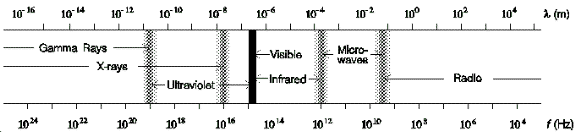
Unlike optical and infrared imaging sensors which are inherently passive, meaning they rely on reflected or radiated energy, radar is an active sensor--providing its own illumination in the form of microwaves. Microwaves are electromagnetic (EM) waves in approximately the 1-1000 GHz region of the EM spectrum, as illustrated in Figure 1.
An electromagnetic wave is a self-propagating wave (requiring no medium to travel through) consisting of electric and magnetic fields whose intensities follow a sinusoidal pattern. These fields are perpendicular to each other and in phase as shown in Figure 2.
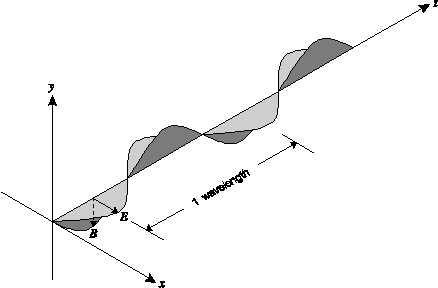
One wavelength ( ) is the distance from one crest to the next crest. The frequency (f)
of the wave is the number of crests to travel one wavelength per unit
time. The propagation velocity (or phase velocity) of the wave is
dependent on the medium through which it is traveling. It is calculated
as:
) is the distance from one crest to the next crest. The frequency (f)
of the wave is the number of crests to travel one wavelength per unit
time. The propagation velocity (or phase velocity) of the wave is
dependent on the medium through which it is traveling. It is calculated
as:

where  and
and  are
the permeability and permittivity, respectively, of the medium. These
are inherent electromagnetic qualities specific to different types of
matter. The lowest values these can have are 0and 0 which occur for a vacuum (free space). Thus the maximum velocity of light is within a vacuum and is equal to:
are
the permeability and permittivity, respectively, of the medium. These
are inherent electromagnetic qualities specific to different types of
matter. The lowest values these can have are 0and 0 which occur for a vacuum (free space). Thus the maximum velocity of light is within a vacuum and is equal to:

Air is so diffuse that within it the velocity of an EM wave can still be considered to be c. The wavelength and frequency are related to the velocity by the equation:

where v is the velocity in metres per second, f is the frequency in Hertz (cycles per second) and is the wavelength in metres.
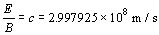
The ratio of the electric field intensity E to the magnetic field intensity B at any moment is always equal to the speed of light in a vacuum.
The polarization of the EM wave refers to the direction of the electric field vector. In radar science, the wave is said to be polarized in the direction of its E vector.
The two main types of radar images are the circularly scanning plan-position indicator (PPI) images and the side-looking images. The PPI applications are limited to the monitoring of air and naval traffic. Remote sensing applications use the side-looking images which are divided into two types--real aperture radar (usually called SLAR for side-looking airborne radar or SLR for side-looking radar) and synthetic aperture radar (SAR).
The SLAR imaging system uses a long, straight antenna mounted on a platform (aircraft or satellite), with its longitudinal axis parallel to the flight path. The antenna emits pulses of electromagnetic energy directed perpendicular to the flight path of the platform and downward to the surface of the Earth, as illustrated in Figure 3. These pulses fall within a narrow area on the ground and are scattered, usually in many directions, including the direction of the antenna. The return echoes arrive at the antenna at different times, depending on the distance from the antenna to the specific scattering object on the ground.
大科學裝置是探索未知、突破前沿的“國之重器”,是支撐基礎科學研究和取得原創性突破的關鍵科技基礎設施。中國科學院一批大科學裝置持續運轉,成為探索科學無人區的前沿陣地。自今日起,本報開設“探訪大科學裝置”......
戴上眼鏡,即便隔著水泥墻,你也能感知墻背后的人體呼吸和……這不是科幻,而是我國雷達探測生命技術的最新應用場景。7月23日,在接受科技日報記者采訪時,空軍軍醫大學軍事生物醫學工程學系教授王健琪介紹:“我......
5月20日,在國際超級雙極光雷達網(SuperDARN)2024年研討會上,我國北方中緯高頻雷達網發布首批科學探測結果。探測結果顯示,5月10日,特大磁暴期間,從世界時6時30分至7時30分,太陽耀斑......
原文地址:http://news.sciencenet.cn/htmlnews/2023/8/506721.shtm劉永坦(1936年—)中國雷達與信號處理技術專家,中國科學院院士、中國工......
法國國家科學院里昂高等師范學院的科學家最近開發出了首個基于微波的量子雷達,其性能比現有傳統雷達高20%,實現了所謂的“量子優越性”。相關研究發表于最新一期《自然·物理學》雜志。最新研究負責人之一本杰明......
7月10日晚,乘坐由上海虹橋飛往北京首都的國航CA1524航班的網友稱,在空中經歷嚴重顛簸。“最后30-40分鐘左右,突然一個下墜,這極短的間隔,又一次猛烈下墜,把正在幫助乘客歸位的空姐、乘客,都拋到......
英國科學家首次展示了一種新型激光雷達系統,其使用量子探測技術在水下獲取3D圖像。該系統擁有極高的靈敏度,即便在水下極低的光線條件下也能捕獲詳細信息,可用于檢查水下風電場電纜和渦輪機等設備的水下結構,也......
2021年9月15日21時35分,第十四屆全國運動會開幕式在熱烈的氣氛中圓滿結束。10分鐘后,一場大雨如期而至。據氣象部門預測,當晚有一次強降水過程。如果在國家領導人致辭、運動員入場、文藝演出或火炬點......
近日,“中國復眼”成功開機觀測,拍攝了國內首張月球環形山地基雷達三維圖像。“中國復眼”是我國首個大規模分布孔徑深空探測雷達。由入駐重慶兩江協同創新區的北京理工大學重慶創新中心謀劃建設。該設施由很多小天......
6點起床,跑步、吃早飯,8點前到達辦公室。改論文、與學生討論科研和思想,和同行論證國家重大需求或對國計民生有價值的項目——馬不停蹄,一直忙到晚上11點左右回家。這是南京航空航天大學教授潘時龍的“一日作......