
With users ranging from enterprise level data centres to single consumers with smart phones requiring higher bandwidth, the demand for newer technologies to deliver these higher data transmission rates is bigger than ever before.
A wide range of technologies exist for the delivery of high throughput, with fibre optic cable considered to be the highest standard. However, fibre optics is not unmatched, especially when all considering economic factors. Millimetre wave wireless technology offers the potential to deliver bandwidth comparable to that of fibre optics but without the logistical and financial drawbacks of the deployments.
Millimetre wave represent the RF Signal spectrum between the frequencies of 30GHz and 300GHz with a wavelength between 1 - 10 millimetres but in terms of wireless networking and communications equipment, the name Millimetre Wave generally corresponds to a few select bands of radio frequencies found around 38, 60 and, more recently, the high potential 70 and 80 GHz bands that have been assigned for the public domain for the purpose of wireless networking and communications.
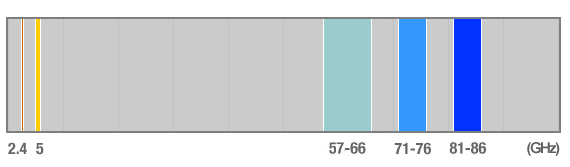
The image below shows the spectrum from 0 - 100GHz with the most popular Wireless Networking Frequency bands located to represent how much bandwidth is available in the Millimetre Wave regions.
In the UK, there have been 3 frequency bands that have been allocated for commercial Millimetre Wave usage, these are as follows:
57 - 66GHz: The 60GHz Millimetre Wave Band or V-Band is governed by OFCOM for licensed operation. The large amount of signal absorption via atmospheric oxygen and tight regulations make this frequency band more suited to short range, Point-to-Point and Point-to-Multipoint Millimetre Wave solutions. Between 57 - 64GHz the band is licensed and regulated but from 64 - 66GHz the band is unlicensed and self coordinated.
71 - 76GHz and 81 - 86GHz: The 70GHz and 80GHz Millimetre Wave Bands or E-Bands are governed by OFCOM for licensed operation only and are regarded to be the most suited band for Point-to-Point and Point-to-Multipoint, Millimetre Wave Wireless Networking and communication transmission. Each band has a 5GHz spectral range available which totals to be more than all other assigned frequency bands added together. Each 5GHz range can act as a single contiguous wireless transmission channel allowing very efficient use of the whole band and in turn these result in high throughput speeds from 1 to 3 Gbps whilst only using simple modulation techniques such as OOK (On-Off-Keying) or BPSK (Binary Phase Shift Keying). These throughput speeds are substantially higher than those found in lower frequencies using much more complex and advanced orders of modulation so even higher throughput speeds should be achieved with Millimetre Wave devices when utilising the same advanced techniques. It should be only a matter time before market demand brings these to the forefront.
In the US, another band is available alongside the 3 listed above which is::
92 - 95GHz: The 94GHz Millimetre Wave Band or W-Band is governed by the FCC Part 15 for unlicensed operation also but only for indoor usage. It may also be used to outdoor Point-to-Point applications following the FCC Part 101 regulations but due to a range between 94 - 94.1GHz being excluded, the band is less spectrally efficient than the others.
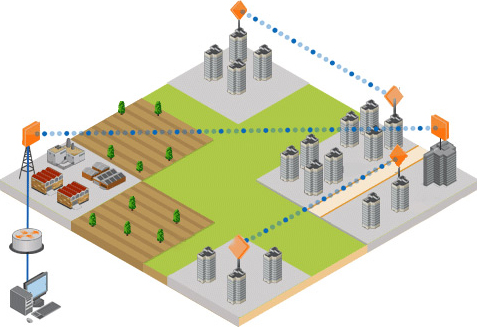
Whilst the number of economic and commerce buildings continues to grow in and around city areas, the requirement for high bandwidth internet is as high as it has ever been. However, many of these buildings rely on old infrastructure transmitting data over out-of-date copper wire due to them not being connected to the main fibre optics grid, strangling the efficiency of business operations.
Despite the majority of these buildings being located within a couple of miles from the fibre optic grid or ring there have previously been no practical and cost effective solutions to install a connection; this is where Millimetre Wave technology can help. By installing a Point-to-Point Millimetre Wave link from a building connected to the fibre optic ring to the target building a high bandwidth, very reliable connection can be made comparable to the actual metro network ring itself.
近日,電子科技大學自動化工程學院研究團隊在期刊《神經網絡》上發表研究性論文。該文首次提出毫米波近場透視成像與可見光的圖像融合方法。隨著目標檢測技術的快速發展,多種傳感器在提升檢測精度方面發揮著關鍵作用......
工業和信息化部日前發布新版《中華人民共和國無線電頻率劃分規定》,將于7月1日起正式施行。據工業和信息化部相關負責人介紹,新修訂的劃分規定率先在全球將6GHz頻段劃分用于5G/6G系統。6GHz頻段是中......
現代信息社會中,移動通信是實現信息高效流動的基本手段。近期,第五代移動通信系統(5G)已實現大規模商用。當前,5G長期演進和第六代移動通信系統(6G)成為學術界和產業界的研究熱點。實現高通量無線通信的......
毫米波(名詞解釋?)與太赫茲波(名詞解釋?)探測技術在通信、安全、生物檢測、頻譜分析等領域有著廣泛的應用。它們是將承載著毫米波與太赫茲波的光信息轉變為電信號的核心技術。高靈敏度、寬波段、快速響應及面陣......
近日,由中國科學院沈陽自動化研究所團隊與以色列魏茨曼科學院(WeizmannInstituteofScience)研究團隊,聯合提出了針對多輸入多輸出(Multiple-InputMultiple-O......
在時間某處,也許就是此刻新一代的技術變革正激發全新理念的誕生作為未來科技的推動者我們幫助從事前沿研究的高校、公司、研究機構,開啟測量新視野使其產品從概念到商用,速度更快科技的迅猛發展帶來了很多新的變化......
今日推薦文章作者為東南大學毫米波國家重點實驗室主任、IEEEFellow著名毫米波專家洪偉教授,本文選自《毫米波與太赫茲技術》,發表于《中國科學:信息科學》2016年第46卷第8期——《信息科學與技術......
對于投資者來說,軍民融合一直是雙創中一個重要的領域,由高校實驗室走出的項目往往具有高精尖等特點。但是另一方面,這些項目往往都是軍轉民,而且項目長期處于高校之中難以發現。為了提高科技成果轉化,支撐產業發......
由北京航空航天大學承擔的“新能源汽車”重點專項“電動汽車智能輔助駕駛關鍵技術研究與產品開發”項目“智能輔助駕駛環境感知關鍵技術研究與產品開發”課題研究取得階段性成果。課題重點圍繞77GHz毫米波雷達關......
分析測試百科網訊2017年2月23日,國家重大科學儀器設備開發專項“毫米波成像探測儀研制及產業化示范”項目(2012YQ140037)初步驗收會在同方威視密云基地召開。國家科技部資源配置司副司長吳學梯......