
Human-pathogenic fungi such as Coccidioides immitis and Histoplasma capsulatum must be handled in Biosafety level 3 containment facilities which make for a very awkward working environment (J.Y. Richmond and R.W. McKinney, eds. Biosafety in Microbiological and Biomedical Laboratories, 3rd ed. NIH, Washington). In this paper we describe a safe and convenient method of extracting DNA from such fungi in which the culture is killed by steaming, allowing removal from the containment facilities, as soon as possible. The method was first developed with the non-pathogen Neurospora crassa, has worked well for both C. immitis and H. capsulatum, and should be useful for extracting DNA from any pathogenic fungus.
Cultures of C. immitis are grown in the saprophytic phase at 37 C in 100 ml of 2X GYE medium (20 g glucose and 10 g yeast extract in 1 liter medium, autoclaved for 15 min.) in 500 ml plastic Nalgene flasks with plastic foam stoppers (Identi-plug, Fisher). When there has been sufficient growth, the whole container is transferred to an autoclave and steamed at 1 atm (100 C) for 15 min. This raises the temperature of the culture to about 95 C (as measured in trials with a thermocouple). The culture is allowed to cool, 1 ml is plated on 2X GYE or potato dextrose agar, and the rest frozen at -20 C. If there is no growth on the plate after 1 week, the culture is assumed to be dead and is removed from the containment room to proceed with the DNA extraction.
Cultures are thawed, filtered, frozen in liquid nitrogen, lyophilized, and ground with a mortar and pestle. About 10 mg of dry ground tissue is mixed with 400 ul lysis buffer (50 mM Tris, 100 uM NaCl, 5 mM EDTA, 1 sodium dodecyl sulfate), and incubated at 80 C for 10 min., cooled to 40 C and incubated with 10 ul of 10 mg/ml Proteinase K for 2-3h, and then incubated again at 80 C for 10 min. The DNA is then extracted with chloroform- phenol and precipitated with isopropanol, following Lee and Taylor (In: M. A. Innis et al, eds. PCR Protocols, pp. 282-287, Academic Press, San Diego). The pellet is resuspended in 100 ul TE, and 5 ul of this is electrophoresed in agarose to check the yield - usually there is an easily visible band of high molecular weight DNA (Figure 1). We have successfully amplified the DNA by PCR and sequenced the product directly.
The main innovation of this protocol is the use of steam to kill the culture. By doing this at an early stage, right in the culture flask, exposure to the fungus is minimized. In trials with Neurospora crassa, steaming at 1 atm gave a much higher yield of DNA than autoclaving under pressure. The addition of Proteinase K to the lysis buffer also increases yield (Figure 1), presumably by digesting away proteins which are bound to the DNA and denatured by the heat.
Acknowledgements: Norman Pace suggested the lysis buffer recipe and the use of Proteinase K. Financial support came from NIH-NIAID grant AI28545.
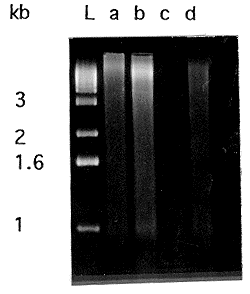
Figure 1. Genomic DNA extracted from 10 mg lyophilized C. immitis after killing with steam. a, b: strain 1; c, d: strain 2; a, c: without Proteinase K; b, d: with Proteinase K; L: 1 kb DNA size ladder (Gibco BRL). Gel was treated with RNAse after electrophoresis.
美國加州大學圣迭戈分校研究人員利用高通量DNA測序和人工智能技術,解碼了人類基因中一段名為“起始子”的關鍵DNA序列特征。這項成果為解析基因表達調控規律和預測DNA突變影響提供了新工具。相關論文發表于......
1587年10月一個溫暖的日子,意大利托斯卡納大公弗朗切斯科·德·美第奇因高熱不治而亡。接診醫生初步判定死因是瘧疾,但很快坊間流言四起,不少人猜測他是遭心懷嫉妒的弟弟費迪南多下毒謀害。如今,全新的科學......
迄今規模最大的古代人類DNA研究表明,人類進化在過去1萬年里明顯加快。這項由美國哈佛醫學院的群體遺傳學家DavidReich聯合主導的研究,4月15日發表于《自然》。研究人員在涵蓋歐洲和中東地區的古代......
近日,中國科學院青島生物能源與過程研究所單細胞中心與中國科學院天津工業生物技術研究所合作,研究開發了一種集成的、高靈敏度且高通量的錯誤校正平臺eMBS。能夠通過理性設計工程化MutS蛋白并結合磁珠分離......
據報道,上個月法國發生的一起案件,在一把槍上發現了同卵雙胞胎兄弟的DNA,但他們擁有相同的DNA,所以傳統的DNA檢測方法,無法確定DNA屬于哪位兄弟。在法國一起刑事審判中,傳統的DNA檢測未能區分出......
27日的《科學》雜志發表了一項研究,揭示了人類基因組中一類可“跳躍”的DNA片段——被稱為遺傳“寄生蟲”的LINE-1(L1)元件,如何成為破壞癌癥基因組穩定性的主要力量。基因組的不穩定正是癌癥演化的......
一艘沉沒于150年前的船經歷了怎樣的航程?科研人員從出水瓷瓶內的沉積物中,“打撈”出了它的生命史。通過對長江口二號沉船出水青花雙耳瓶中的土壤沉積物進行環境因子與沉積物古DNA分析,來自復旦大學、華東師......
在近日一項發表于《自然》的研究中,科學家繪制出迄今最詳盡的人類活細胞內DNA折疊、環狀纏繞和移動的圖譜,展示了基因組結構隨時間推移的變化情況,揭示了隱藏的基因調控機制,是了解DNA結構如何塑造人類生物......
圖基于卷對卷流體的新一代快速低成本基因測序技術在國家自然科學基金項目(批準號:22027805、22334004、22421002)等資助下,福州大學楊黃浩、陳秋水團隊與華大生命科學研究院秦彥哲、章文......
荷蘭烏得勒支大學研究人員開發出一款全新熒光傳感器,可在活細胞乃至活體生物中實時監測DNA損傷及修復過程,為癌癥研究、藥物安全測試和衰老生物學等領域提供了重要的新工具。相關成果發表于新一期《自然·通訊》......